
First, why does a composer need a business model?

Being a composer is running a business. Even more so now, than ever.
In fact, forget about building a composer career — Let me explain what I mean with that.
The traditional, set routes of pursuing a career as a composer are working less and less—especially for those just starting out. In today’s industry, waiting for a “career path” to reveal itself is no longer enough. As composers, we are all uniquely positioned to share something only we can offer, and success comes from understanding how to communicate that uniqueness to the world.
Rather than focusing solely on building a career title, the real shift lies in developing a strong business model and personal brand that reflects your authentic musical voice. This doesn’t mean abandoning dreams of becoming a successful film composer; it means creating pathways that attract the right projects, lead to more rewarding collaborations, and bring recognition that truly aligns with who you are as a composer and music creator.
With all this being said, what should be our steps moving forward?
Essential Checklist for a Composer’s Business:
Your Business Model Canvas - A method for building and ensuring a foundation for your pursuit as a composer.
At least a 1 page business plan and outline.
Value Proposition Canvas - A means to measure the value you bring to the market and customers.
Clear guidelines and understanding of negotiating composer fees.
A solid understanding of music rights, royalties and licensing.
Written Composer Agreement templates for media and non-media projects
A website to showcase your work - it doesn’t matter what stage you are in your career!
A Social Media Plan and Schedule to post your music, skillset and knowledge (and being creative about it!)
Essential equipment and software. Watch a video here.
We look forward to diving into these further (with some FREE resources) so stay tuned!
What is a BMC and why should composers need one?
The tool and concept was developed by Alexander Osterwalder and Yves Pigneur in 2005. It is an approachable tool available for entrepreneurs and individuals in business, to ensure a business is viable. The BMC consists of nine components – customer segments, value proposition, channels, customer relationships, revenue streams, key resources, key activities, key partners and cost structure.
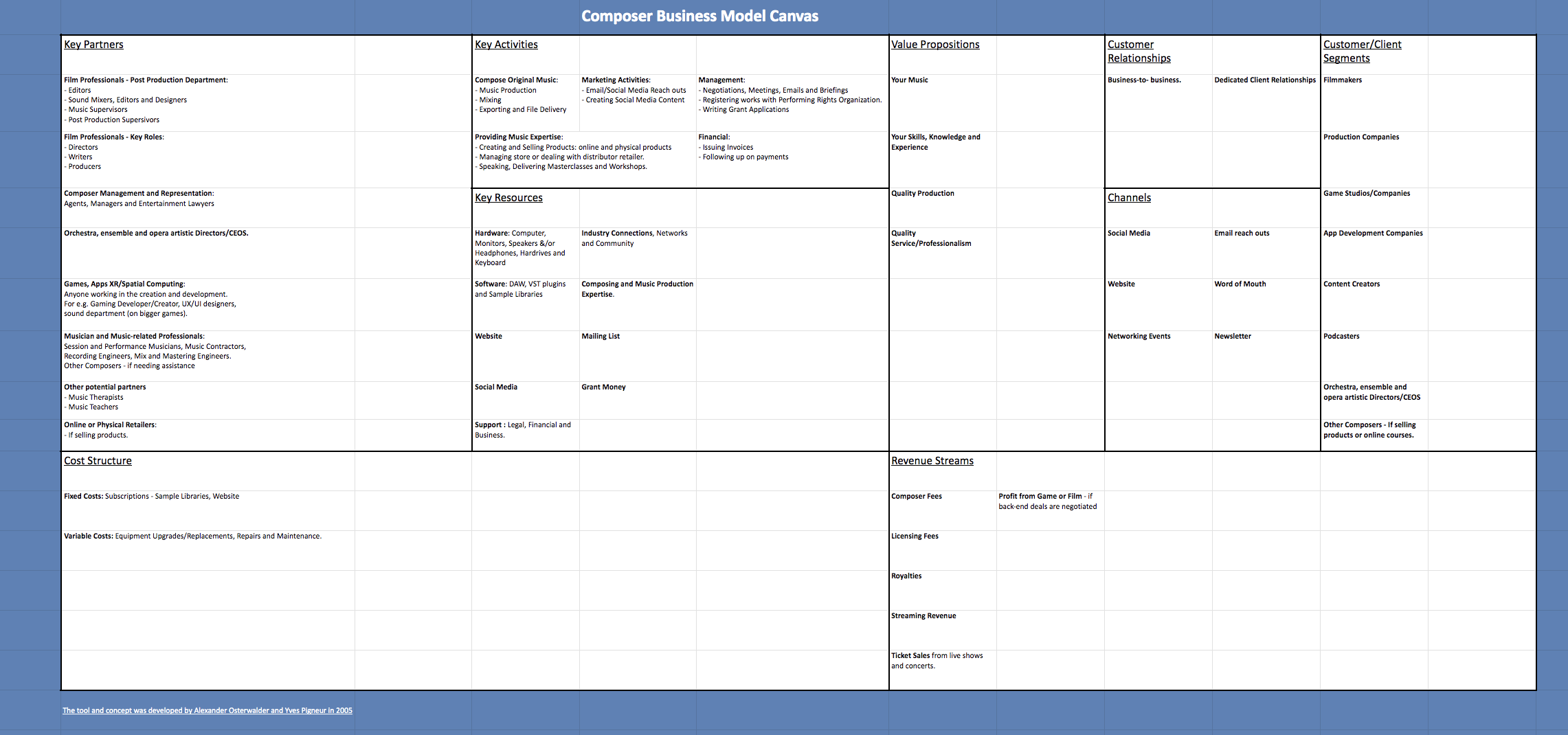
For more information and history on the BMC visit the strategyzer website here.
A Business Model Canvas (BMC) can be a valuable tool for composers in the early stages of their careers, helping them clarify their business approach, stay on track, and plan strategically for the future.
Here is an overview of a BMC for Composers. It can also be adapted and edited for music creators, other creators such as filmmakers as well other creative businesses!
Download for a FREE Composer BMC free resource is available at the bottom of this page.
Here is a Business Model Canvas analysis for Composers
Value Proposition
Value Proposition addresses the value a composer and their business offers to its clients and customers and why they are chosen for their product and service. It highlights how a product or service solves a problem, fulfills a need, or provides a distinct benefit.
For a Composer this could include:
Your Music - your unique style and how you can deliver the style the client needs.
Your Skills, Knowledge and Experience - your understanding of the field you are working in, and its needs.
Quality Production - Professional sounding music and quality.
Quality Service/Professionalism - Strong collaborative and communication skills, meeting deadlines, delivering files professionally.
Key ACTIVITIES
Key Activities are the main actions a business takes to deliver its value proposition, connect with clients or customers, and generate income.
Compose Original Music:
Music Production
Mixing
Exporting and File Delivery
Marketing Activities:
Email/Social Media Reach outs
Creating Social Media Content
Management:
Negotiations, Meetings, Emails and Briefings
Registering works with the Performing Rights Organization.
Writing Grant Applications
If selling products - managing an online store or dealing with retailers.
Providing Music Expertise:
Creating and Selling Products: Online and physical products
Speaking, Delivering Masterclasses and Workshops.
Financial:
Issuing Invoices
Following up on payments
key PARTNERS
Key Partners are other organizations and individuals with whom you may work directly. They are an essential part of delivering your products and/or services and help you reach a wider community and market.
Film Professionals - Post Production Department: Editors, Sound Mixers, Editors and Designers, Music Supervisors, Post Production Supersivors.
Film Professionals - Key Roles: Directors, Writers and Producers
Composer Management and Representation:Agents, Managers and Entertainment Lawyers
Orchestra, ensemble and opera artistic Directors/CEOS.
Games, Apps XR/Spatial Computing: Anyone working in the creation and development.
Musician and Music-related Professionals: Session and Performance Musicians, Music Contractors, Recording Engineers, Mix and Mastering Engineers.
Other Composers: if needing assistance and community (we all need this)!
Other potential partners: Music Therapists, Music Teachers
Online or Physical Retailers: If selling products.
Channels
Channels in the BMC are how a business reaches its customer segments through marketing and distribution.
Channels that composers might use to reach their customer and client segments include:
Social Media
Composer and Business Website
Networking Events
Email reach outs
Word of Mouth
An E-newsletter
Customer Segments
Customer segments refer to groups of people, companies and organizations that a business will be attending to with the products and services it provides, as well as those towards whom marketing strategies will be directed.
For composers, client/customer segments can include:
Filmmakers, Production Companies, Game Studios/Companies, App Development Companies, Content Creators and Podcasters - who want to hire us for composing bespoke music or licensing our music for use.
Other Composers and Music Creators - If selling products or online courses.
Orchestra, ensemble and opera artistic Directors/CEOS - who may have received funding and are looking to commission original work.
These customer segments identify where and how we have the opportunity to provide our services and music products. For composers, it is important to note that customer segments can also double up as key partnerships, as our client relationships are dedicated business-to-business connections.
Customer Relationships
Customer Relationships refer to how a business communicates and connects with its clients and customers. These can include close and more dedicated, collaborative relationships (for example, community forums), or transactional ones, where there is minimal interaction with the customer involved (for example, an e-commerce store).
Dedicated client relationships are involved when a composer is working with their clients, such as filmmakers, game and app developers, and other content and media creators. This can also extend to projects outside the media and tech industries, where a composer builds relationships with others who may hire them for original music, such as orchestra, ensemble, and opera artistic directors/CEOs.
The nature of these relationships can often be described as business-to-business, with the composer being one entity and the client needing music as another. However, that being said, there are occasions when a composer might be hired to compose music for a client with a more personal cause—for example, a personalized song for a wedding or to commemorate a life.
If a composer also sells products on their website, the relationship with the customer is considered more transactional, as there is little to no interaction before, during, or after the purchase is made.
Revenue Streams
Revenue Streams are the different ways a business monetizes and generates income. Customer or client segments directly generate income for a business. Key partnerships can also play an important role in how a business generates revenue, due to the highly collaborative nature of our work.
A composer has many different ways of generating revenue. Some of the considerable ways include:
Composer Fees
Licensing Fees
Royalties
Streaming Revenue
Product Sales for e.g. Sheet Music Sales, Online Courses, Merchandise, E-books, Resources etc.
Live Show Ticket Sales
Profit from Projects (if backend deals are negotiated) for e.g. Box office tickets or Game Sales.
Key Resources
Key Resources are a business’s assets, which are essential for delivering its products and/or services. These can be a combination of tangible, intangible, human, and financial resources. Examples for composers include:
Hardware - Computer, Monitors, Speakers &/or Headphones, Hard drives and Keyboard
Software - DAW, VST plugins and Sample Libraries
Website
Social Media Channels and Following
Mailing List Following
Support - Legal, Financial and Business.
Industry Connections, Networks and Community
Composing and Music Production Expertise.
Grant Funds/Government Funding.
Cost Structure
The Cost Structure section of the BMC details all the main expenses that need to be considered when running the business. These can be divided into fixed and variable costs:
Fixed Costs: Subscriptions - For e.g. Sample Libraries and Website.
Variable Costs: Equipment Upgrades/Replacements, Repairs and Maintenance.
And remember, building a composer business model is a long-haul journey!
Your focus should be building a sustainable business model and structure that you can follow through with and keep up with demand and adapt to market needs. Building a foundation that provides stability and greater potential for longevity.
Also remember, planning your business in a way that you do not burn out is also a long-term strategy! One of the best things you can do for yourself and your career/business as a composer is to negotiate realistic deadlines and goals! This is not just an act of self-care, but also a strategy for consistency, building a reliable and solid brand and foundation for your business.
Next Resource to stay tuned for - Business Plan Table for Composer.
Visit the following links to learn more about our Coaching & Consultation Programs .
We have a free filled-in and editable Composer BMC Excel spreadsheet document for your use. It can also be adapted for other music creators, filmmakers, other creatives, and business owners.
PLEASE NOTE: THE INFORMATION PROVIDED ABOVE AND IN THE FREE RESOURCE IS A GENERAL START UP/PROMPT GUIDE. PLEASE BE DISCERNING TO YOUR OWN CIRCUMSTANCES.
Instructions for downloading :
Fill in your name and email address in the form below*.
Click the Download Composer BMC button below.
The download will commence automatically and you’ll receive a FREE excel spreadsheet for edit and use. Enjoy!
Tip: We recommend you download the file on a computer. So fill in the form on a computer, rather than on a phone!
*Our e-newsletter is sent 4 times a year. It includes industry info, and some news from our end. You can unsubscribe at any time.